Buying a property is likely the most significant investment you will ever make. While most people wouldn't dream of skipping a general structural report, a thorough home buyer sewer inspection in Brooklyn or Queens is often overlooked until it is far too late. At NY Sewer Cam, we specialize in providing total clarity before you sign those final closing papers. Because we operate as an independent inspection company rather than a repair-focused plumbing firm, our only goal is to provide an honest, unbiased look at what is happening beneath the ground.
In the high-stakes world of New York real estate, what you don't see can absolutely hurt your bank account. Most buyers focus on the gleaming hardwood floors or the updated kitchen cabinets, but the most expensive potential failure in the house might be buried six feet under the front lawn. Understanding the state of the waste line is not just a recommendation; it is a fundamental part of responsible homeownership.
Why a Sewer Scope is Essential for Due Diligence
A standard home inspection typically covers the roof, the electrical panel, and the HVAC system. However, that inspection almost always stops exactly where the plumbing disappears under the foundation. The main sewer lateral—the pipe connecting the home to the municipal main—is the homeowner's responsibility. If that pipe is cracked, invaded by aggressive tree roots, or collapsing, the repair costs can be staggering.
In the five boroughs, these repairs are particularly complex. Because of NYC Department of Environmental Protection (DEP) regulations and the sheer depth of some lines, a simple dig can quickly escalate. Repairing a line that runs under a sidewalk or into a busy street often requires expensive permits and specialized contractors. This is why conducting a professional sewer scope during your due diligence period is so critical.
By identifying these "invisible" deal-breakers early, you gain leverage. Whether the property features century-old clay pipe deterioration or more modern PVC with shifting joints, knowing the condition of the line is vital. This information allows you to negotiate property closing costs or request specific repairs before the title officially transfers. Without a camera, you are essentially gambling on the integrity of the underground infrastructure.
The Benefits of an Independent Pipe Survey
There is a significant conflict of interest in the plumbing industry that many buyers don't realize. Many plumbing companies offer camera services as a "loss leader." They provide a cheap or even free inspection with the primary goal of selling expensive hydro-jetting services or full-pipe replacements. At NY Sewer Cam, we operate on a completely different model. We provide a truly independent pipe survey.
Since we do not perform repairs, we have no financial incentive to find problems that aren't there. We don't make a commission on excavations or pipe lining. Our technicians focus solely on a high-definition home buyer sewer inspection, delivering a clear video and a detailed report of the pipe's interior. This independence ensures that if we say a pipe is in good condition, you can trust that it actually is.
A comprehensive pre-purchase sewer camera test can reveal several common issues that a surface-level inspection would miss:
Tree Root Intrusion: Roots are naturally drawn to the moisture and warmth inside a sewer line. They can enter through even the smallest hairline cracks in old clay pipes. Once inside, they grow rapidly, creating a "bird's nest" that catches debris and eventually causes total blockages.
Bellies or Sags: Over time, the ground beneath a pipe can shift or settle, causing a section of the line to sink. These low spots, known as bellies, allow water and waste to pool. This often leads to recurring backups and the accumulation of "sludge" that can eventually harden and close off the pipe.
Offset Joints: In older installations, sections of pipe were often "tapped" together. If the soil shifts, these joints can become misaligned. This creates a sharp lip inside the pipe that catches toilet paper and solid waste, leading to frequent and frustrating clogs.
Pipe Corrosion and Channeling: This is especially common in older cast iron lines. Over decades, the bottom of the pipe can actually rot away—a process called channeling. While the pipe might look fine from the top, the bottom is missing, allowing waste to dump directly into the soil under the house.
What to Expect During the Inspection Process
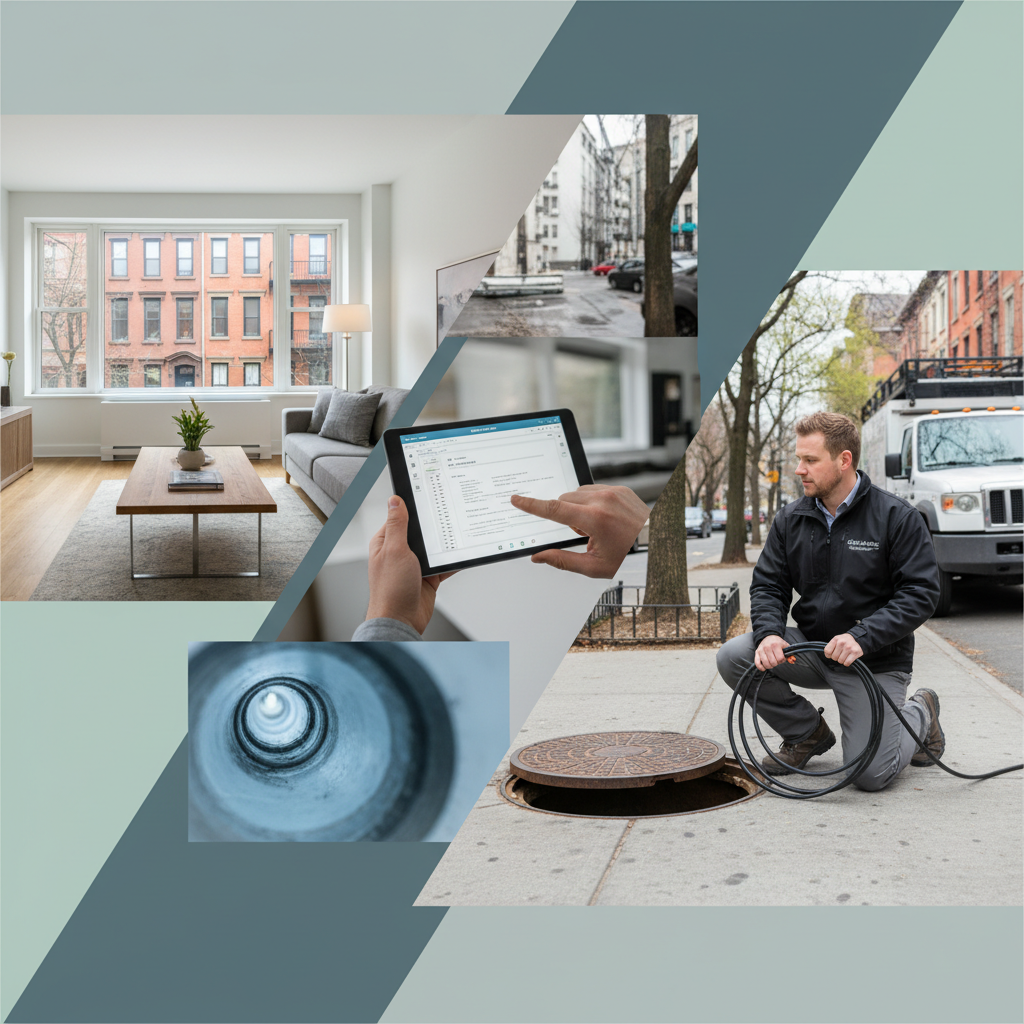
The process managed by NY Sewer Cam is designed to be straightforward and non-invasive. Our technician begins by locating the sewer clean-out, which is usually found in the basement, a crawlspace, or sometimes in a small pit near the front of the house. We then feed a specialized, high-resolution waterproof camera through the line.
The feed is monitored in real-time on a high-contrast monitor, allowing the technician to see every crack, root, and build-up of scale. The entire drain line video inspection is recorded. We don't just tell you what we see; we show you. If we find an area of concern, we use signal-emitting transmitters to locate the exact spot and depth of the issue from above ground. We can mark the spot with paint or a flag, saving you from unnecessary excavation costs later if repairs are needed.
In the competitive New York real estate market, having this data can be a powerful tool. It transforms a potential disaster into a manageable negotiation point. If a line needs $10,000 worth of work, that is $10,000 you shouldn't have to pay out of pocket the month after you move in. NY Sewer Cam provides the evidence you need to ask the seller for a credit or a repair.
Common Pitfalls of Older NYC Properties
Many homes in neighborhoods like Park Slope, Bedford-Stuyvesant, or Astoria still utilize the original clay pipes installed when the neighborhoods were first built. These pipes were designed to last a long time, but they weren't designed for the weight of modern traffic or the invasive roots of large city trees. Furthermore, the transition point where the home's line meets the city's main is a frequent failure point.
If you are buying a "fixer-upper," the sewer line should be your first priority. You can't renovate a kitchen if you can't flush the toilets. Even in newly flipped homes, we often find that developers spent thousands on cosmetic upgrades like quartz countertops but ignored a collapsing sewer line. Don't assume that because a house "looks new" that the infrastructure underneath it is also new.
Frequently Asked Questions
How long does a sewer camera inspection take?
A standard inspection for a residential property typically takes between 45 to 90 minutes. This depends on how easy it is to access the clean-out and whether we encounter significant blockages that slow the camera's progress.
How much does a sewer inspection cost in Brooklyn?
At NY Sewer Cam, our standard inspections start at $249. This is a flat fee that includes the recorded video, high-resolution photos, and a digital summary of our findings. We believe in transparent pricing with no hidden "trip fees" or surprise add-ons.
Doesn't my general home inspector check the sewer line?
Most people are surprised to learn that standard home inspectors do not check the main lateral. They check that the sinks drain and the toilets flush, but they don't have the $10,000 camera systems required to see the actual condition of the buried pipe. It is almost always listed as an exclusion in their contract.
If you find a break, will you fix it for me?
We do not perform any repair work. This is intentional. Because we don't sell plumbing or excavation services, our reports are independent and free from repair-sales incentives. We have no reason to exaggerate a small crack into a major catastrophe. Our job is to give you the facts so you can make an informed decision.
What happens if you can't find a clean-out?
In some older homes, a clean-out might be buried or non-existent. In these cases, we can often perform the inspection by removing a toilet, though this may involve an additional labor fee. We always discuss these options with you before proceeding.
Protecting your investment starts with looking where others won't. Before you commit to a thirty-year mortgage, make sure the most vital artery of your home is functioning correctly. With the help of NY Sewer Cam, you can move forward with confidence, knowing exactly what lies beneath your new home.
Note: NY Sewer Cam provides inspection and diagnostic services only. We are not a licensed plumbing or repair contractor and do not offer pipe repair, cleaning, or installation services.
Residential inspections start at $249 in Nassau County, Queens, and Staten Island. Brooklyn residential inspections start at $299, and Manhattan residential inspections start at $599. Manhattan commercial building inspections start at $1,200.