Buying a home in New York City is often the largest financial commitment a person will ever make. While most buyers wouldn't dream of closing a deal without a thorough examination of the roof, the electrical panel, or the foundation, one critical area is frequently ignored: the pipes buried beneath the sidewalk. A professional sewer line inspection is a practical way to ensure you aren't inheriting a structural nightmare hidden several feet underground. In the dense urban landscape of the five boroughs, what you can't see can definitely hurt your bank account.
In New York, property owners are responsible for the entire length of the lateral line—the specific pipe that connects the building to the municipal main. Because these pipes are buried deep beneath layers of concrete and asphalt, standard home inspections rarely include them. At NY Sewer Cam, we provide a clear, diagnostic view of a potential home's infrastructure to help buyers avoid expensive surprises. Our specialized equipment is designed to navigate the unique twists and turns of historic NYC plumbing systems, providing clarity where there was once only guesswork.
Why Real Estate Due Diligence Requires a Sewer Scope
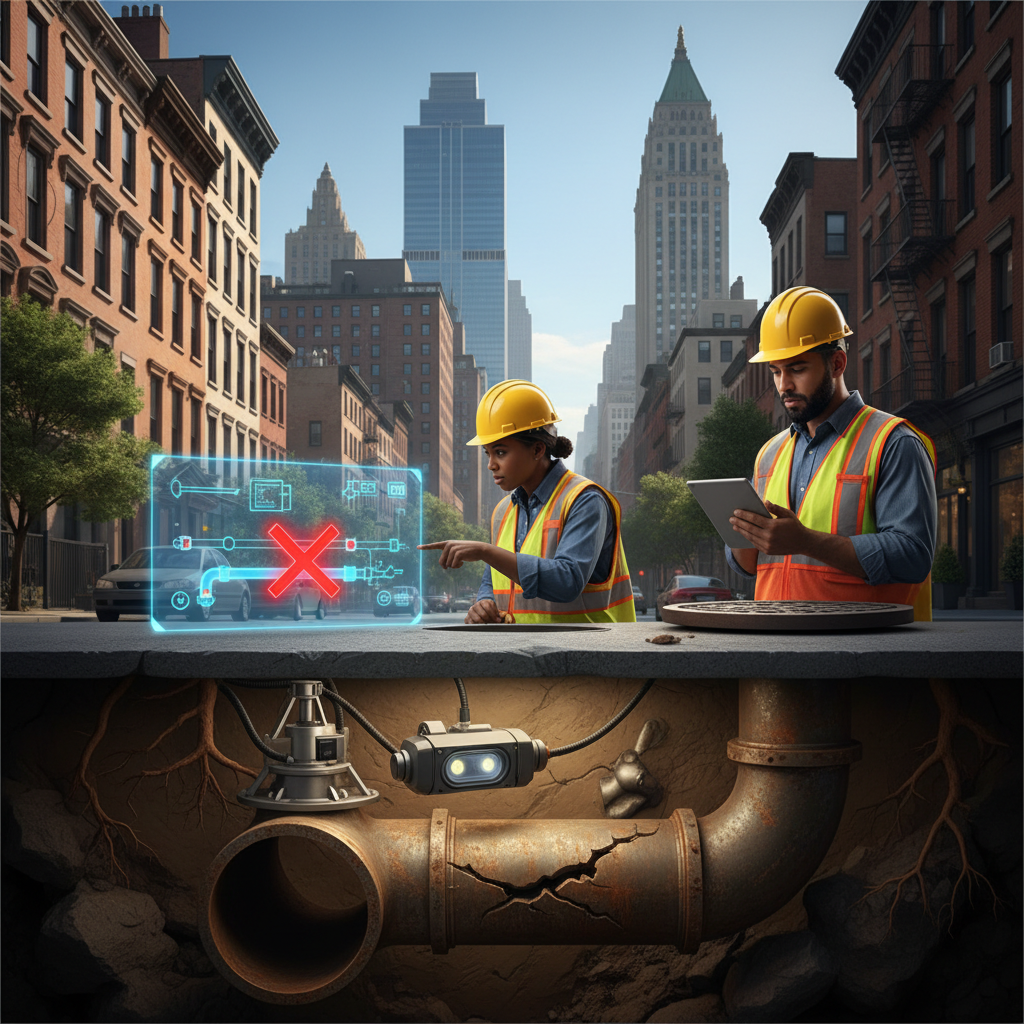
Manhattan and Brooklyn are home to some of the oldest municipal infrastructure in the country. It is not uncommon for our technicians to find clay pipes that have been in continuous service for nearly a century. While these materials were durable for their time, they are not immortal. Over the decades, these pipes can suffer from offset joints, heavy root intrusion from street trees, or complete structural collapse due to shifting soil. The weight of the city itself—thousands of pedestrians and heavy vehicle traffic—exerts constant pressure on these aging conduits.
A sewer scope inspection allows a technician to navigate a high-resolution camera through the entire length of the lateral line. This process identifies issues that a visual surface check or a simple water-drainage test would never reveal. For those performing a home buyer sewer inspection, the goal is total clarity. Knowing the condition of the main line camera check results before you sign a binding contract gives you significant leverage during the closing process. Many buyers assume that if the toilets flush, the system is fine. However, a pipe can be 90% blocked by roots and still allow water to pass, only to fail completely at the most inconvenient moment.
If the camera reveals a belly in the pipe—a low spot where debris collects—or a significant crack, you can negotiate the repair costs with the seller. Without this information, you might discover a $15,000 excavation bill six months after moving in. NY Sewer Cam ensures that you have the visual evidence needed to back up your requests for credits or repairs before the sale is finalized. This evidentiary approach transforms a vague suspicion into a documented fact, which is essential when dealing with real estate attorneys and stubborn sellers.
The Technical Challenges of NYC Infrastructure
The complexity of New York City’s underground environment cannot be overstated. Between the subway lines, utility conduits, and varying soil compositions, the stresses placed on a residential sewer line are immense. In neighborhoods like Park Slope or the Upper West Side, the combination of historic trees and aging clay tile pipes creates a perfect storm for root intrusion. Roots seek out the moisture inside the pipe, entering through tiny gaps in the joints and eventually expanding until they block the flow entirely. Once a root system establishes itself, it acts as a net, catching grease and other debris that would otherwise flow freely to the main.
Furthermore, the transition between different pipe materials is a common failure point. Many older NYC buildings have undergone partial repairs where cast iron meets clay or PVC. If these connections were not made with the proper shielded couplings, they can shift and create "lips" that catch solid waste. By utilizing a sewer line inspection during the due diligence period, buyers can see exactly what materials are in play and whether the connections are structurally sound. Identifying obsolete materials early, such as "Orangeburg" fiber pipe, is a major win for any prospective buyer.
The Value of an Independent Diagnostic Service
One of the biggest concerns for homeowners is the conflict of interest inherent in the plumbing industry. Many companies offer a free or low-cost camera check as a way to get their foot in the door and sell expensive excavation and repair services. Because NY Sewer Cam does not perform repairs, we offer total transparency. We have no incentive to recommend a replacement unless the pipe truly requires it. Our loyalty is to the truth of the pipe's condition, not to a potential construction contract.
This independent approach is essential for NYC building codes compliance and general confidence in your purchase. Whether you are dealing with a pre-war brownstone or a modern development, a drain line video survey provides the digital evidence you need to make an informed decision. Our team at NY Sewer Cam focuses solely on the data, providing you with a high-definition recording and a detailed report. This report can be shared with trusted contractors to get accurate repair bids or presented to the seller's agent to justify a reduction in the asking price.
Understanding the Pipe Deterioration Timeline
Homeowners often wonder how a pipe that worked for decades could suddenly fail. The reality is that pipe degradation is often a slow, invisible process. In New York, the freeze-thaw cycles cause the ground to shift annually. For older cast iron pipes, this movement can lead to corrosion and "channeling," where the bottom of the pipe rots away, allowing sewage to leach into the soil. This can eventually lead to sinkholes or foundation instability.
A plumbing camera service is the only way to catch these issues in the "pre-failure" stage. During our inspection, we look for signs of scale buildup, which narrows the diameter of the pipe, and longitudinal cracking. In many cases, early detection allows for less invasive solutions like pipe relining. However, if the pipe has already lost its structural integrity, full excavation may be the only option. Knowing which category a property falls into before closing is the difference between a smart investment and a financial disaster.
Navigating the Inspection Process
Scheduling an underground pipe inspection is usually a straightforward process that takes about an hour. The technician will typically access the sewer line through a cleanout in the basement—often a brass cap located near the front wall—or by removing a toilet if no cleanout is available. The camera is pushed through the pipe all the way to the city main connection. During this time, the technician looks for "flag" items such as standing water, grease buildup, or structural deformities.
Once the inspection is complete, NY Sewer Cam provides the client with a digital copy of the footage. This is not just a service for buyers; sellers can also benefit by performing a pre-listing inspection. Having a "clean bill of health" for the sewer line can be a strong selling point in a competitive market, proving that the home has been well-maintained. It removes one of the most common hurdles that can derail a deal during the inspection contingency period.
Beyond Residential: Multi-Family and Commercial Needs
The risks are even higher for those looking at multi-family units or commercial spaces. In a residential setting, a backup is a nuisance; in a commercial setting, it can lead to health department violations and lost revenue. A comprehensive inspection for a commercial property involves checking larger diameter lines and ensuring that grease traps are not causing downstream issues. For landlords, regular checks should be part of an annual maintenance schedule to prevent emergency call-outs that disturb tenants and cost significantly more than proactive monitoring.
Frequently Asked Questions
Why isn't a sewer scope included in a standard home inspection?
Traditional home inspections focus on the interior systems and the roof, but they rarely look underground. General inspectors typically lack the specialized fiber-optic equipment and training required to navigate subterranean pipe conditions. In Manhattan's aging infrastructure, the lateral line is the owner's responsibility and can hide thousands of dollars in damage that a standard inspector cannot see.
What is the benefit of hiring an independent inspector over a plumber?
An independent inspector has no incentive to find problems where they don't exist. This prevents a conflict of interest where a plumber might suggest an expensive replacement to win a repair contract. NY Sewer Cam provides only the facts about the pipe's condition, giving you an unbiased baseline for negotiation.
How much does a sewer line inspection cost?
At NY Sewer Cam, our transparent pricing starts at $249 for a comprehensive sewer camera inspection, including digital summary and recorded footage. This is a minimal investment compared to the potential $10,000 to $25,000 cost of an emergency street excavation and pipe replacement.
What areas do you serve?
We cover all five boroughs (Manhattan, Brooklyn, Queens, Staten Island, Bronx) as well as Nassau County on Long Island. We are familiar with the specific geological challenges unique to each of these areas, from the sandy soils of Queens to the rocky terrain of the Bronx.
What happens if the camera finds a blockage?
If the camera cannot pass through the line due to a blockage, we document the exact location and depth using a specialized locating beacon. This information is vital for a cleaning crew or repair team to address the specific problem area without guessing, saving you hours of labor costs.
How long does the digital report take to receive?
We understand that real estate timelines are tight. We typically deliver the video footage and summary report within 24 hours of the site visit, ensuring you have the data you need before your inspection contingency expires.
Ultimately, the cost of a sewer line inspection is a small price to pay for security. In a city where real estate prices are at an all-time high, the last thing a new homeowner needs is a catastrophic backup in their first month. By choosing NY Sewer Cam, you are ensuring that your investment is protected by the most accurate diagnostic tools available today. Whether you are a first-time buyer or a seasoned investor, knowing the state of your underground assets is simply good business.
Note: NY Sewer Cam specializes exclusively in diagnostic camera services. We do not provide plumbing repairs, cleaning, or installation services. Our mission is to provide objective, third-party data to help you make informed property decisions.
Residential inspections start at $249 in Nassau County, Queens, and Staten Island. Brooklyn residential inspections start at $299, and Manhattan residential inspections start at $599. Manhattan commercial building inspections start at $1,200.